With the Brown Stair from EU production children discover size changes in two dimensions. All ten prisms are 20 cm long. Their width and height increase in steps of one centimeter each – from the smallest prism with 1 × 1 × 20 cm to the largest with 10 × 10 × 20 cm.
The child carries the prisms individually to the workspace, holds them, and compares their thickness. Then it arranges the elements from the thickest to the thinnest side by side. When carefully aligned, a staircase with uniform steps is created. This work combines careful observation with controlled movements and the cooperation of both hands.
The uniform brown staining draws attention to the size differences. Accompanying word lessons give the terms thick, thin, thicker, and thinner a vivid meaning. At the constructed steps, high and low can also be compared.
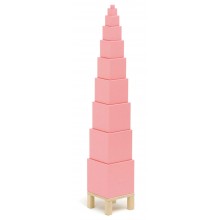
Further arrangements and the combination with the Pink Tower expand the exercise options. Children explore spatial relationships and compare materials whose size changes in two or three dimensions. This lays the first foundations for geometric and mathematical relationships.
This high-quality version of the Brown Stair is manufactured in the European Union.
application possibilities
For kindergarten, Montessori children's house, and the prepared learning environment at home. Suitable for children from 3 years for comparing, sorting, and naming sizes.
Application note
The educator demonstrates the careful carrying, placing, and arranging of the prisms slowly. The child then builds the stair themselves and repeats the exercise at their own learning pace.
Self-control
A wrongly placed prism interrupts the uniform gradation. The child can compare neighboring elements and correct the order themselves.
Product details
- High-quality Brown Stair made of EU production
- Ten brown glazed prisms
- Uniform length: 20 cm
- Smallest prism: 1 × 1 × 20 cm
- Largest prism: 10 × 10 × 20 cm
- Width and height increase in increments of 1 cm
- Classic Montessori sensory material from 3 years
Learning areas
Visual size differentiation, spatial perception, movement coordination, sequences, concentration, and vocabulary related to size ratios.