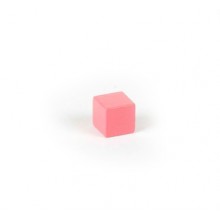

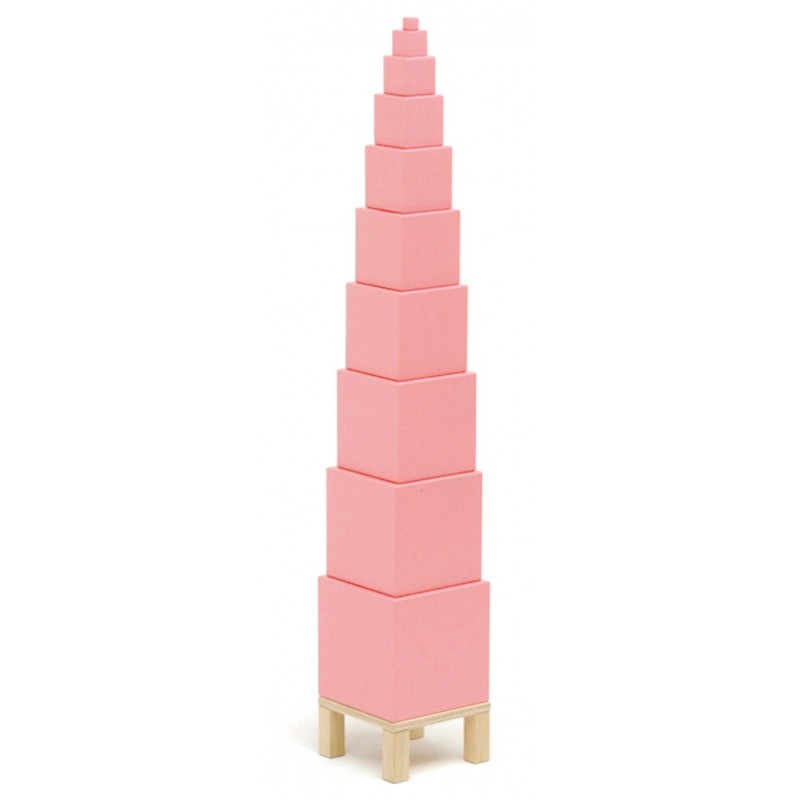

The high-quality pink tower produced in the EU consists of ten pink cubes with edge lengths ranging from 1 to 10 cm. Children aged 3 and up compare the sizes, sort the cubes, and build a graduated tower. This classic Montessori sensory material supports visual size differentiation, spatial perception, and movement coordination.
Please note:
Montessori materials are NOT toys, but educational materials. Proper use requires appropriate training.
Montessori materials may contain small, rough, sharp, or other elements that could cause injury or damage if used improperly.
It may therefore only be used by children under the supervision of appropriately trained persons and in an appropriate environment.
The high-quality pink tower from EU production is one of the fundamental materials of Montessori sensory education. Its ten cubes differ in length, width, and height. The uniform pink color draws attention to these size differences.
The child carries the cubes individually to the workspace, compares their sizes, and builds the tower from the largest to the smallest. By grasping and moving them, it experiences the different dimensions and weights. The precise placement requires coordinated movements and conscious control of the hands.
Through repeated building, the child develops confidence in recognizing and ordering sizes. The cubes can also be arranged lying down or compared in pairs. Terms such as big, small, bigger, smaller, heavier, and lighter are connected with concrete experiences.
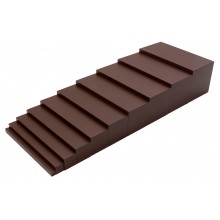
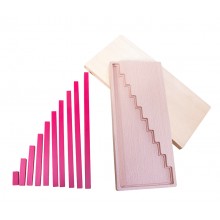
Further exercises with the brown stairs allow for the comparison of size changes in two and three dimensions. Thus, the pink tower connects sensory perception with initial geometric and mathematical foundational experiences.
This high-quality version is manufactured in the European Union and is suitable for repetitive work in the prepared Montessori learning environment.
Areas of application
For kindergarten, Montessori children's house, and the prepared learning environment at home. Suitable for children from 3 years old for comparing, sorting, and naming sizes.
Application note
The educator demonstrates the careful carrying, placing, and stacking of the cubes slowly. The child then builds the tower themselves and repeats the exercise at their own learning pace.
Self-control
A misclassified cube interrupts the uniform size gradation. The child can observe the structure, compare the cubes again, and correct their order.
Product details
Learning areas
Visual size differentiation, spatial perception, movement coordination, sequences, concentration, and vocabulary related to size relationships.
The high-quality pink tower produced in the EU consists of ten pink cubes with edge lengths ranging from 1 to 10 cm. Children aged 3 and up compare the sizes, sort the cubes, and build a graduated tower. This classic Montessori sensory material supports visual size differentiation, spatial perception, and movement coordination.