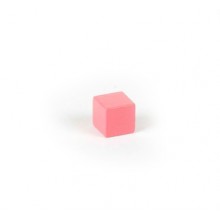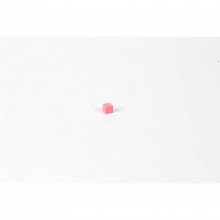

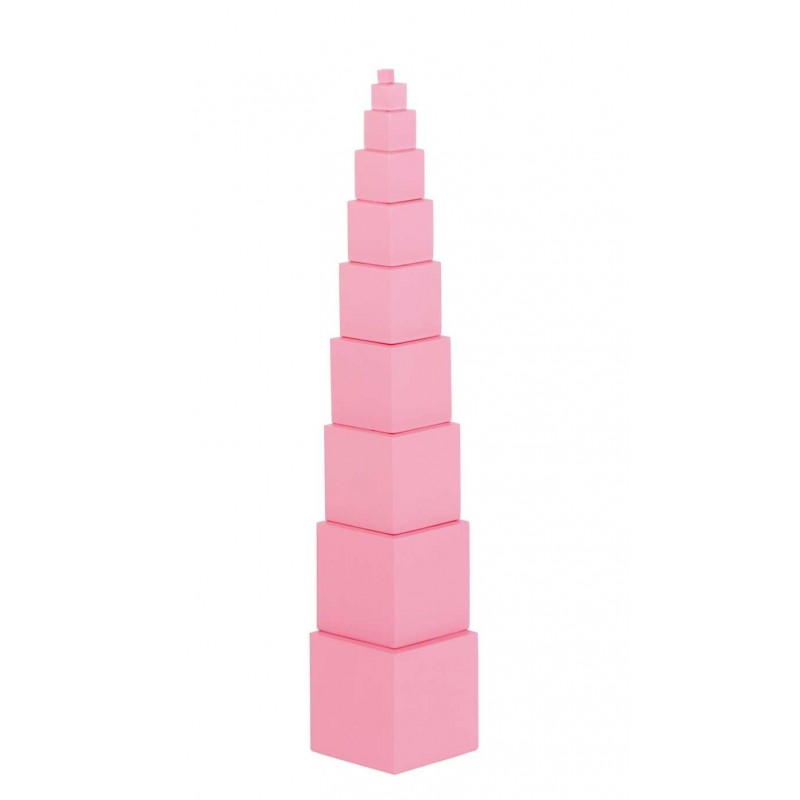

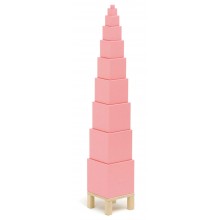
The Pink Tower is one of the classic Montessori sensory materials. Ten pink cubes with edge lengths from 1 to 10 cm invite children from 3 years old to compare sizes, create sequences, and build a graduated tower. The uniform color draws attention to the differences in size.
Please note:
Montessori materials are NOT toys, but educational materials. Proper use requires appropriate training.
Montessori materials may contain small, rough, sharp, or other elements that could cause injury or damage if used improperly.
It may therefore only be used by children under the supervision of appropriately trained persons and in an appropriate environment.
With the Pink Tower children discover how the size of a body changes in all three dimensions. Each cube is larger in length, width, and height than the previous one. The child compares the cubes and stacks them from largest to smallest.
By carrying, grasping, and placing, it connects visual perception with movement. It experiences that larger cubes take up more space and are heavier than smaller ones. The construction requires precise movements: each cube is placed so that a uniformly graduated tower is created.
In addition to building the tower, the cubes can be arranged lying down in a series of sizes. Individual cubes can be compared and related to each other. Accompanying vocabulary lessons give concrete meaning to terms like big and small, bigger and smaller, as well as heavier and lighter a concrete meaning. Additionally, the terms high and low can be introduced.
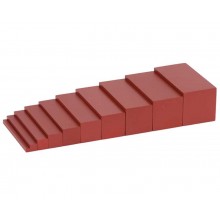
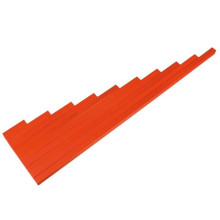
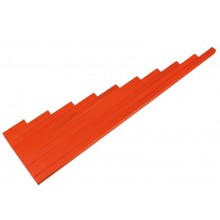
In further exercises, the Pink Tower can be combined with the Brown Stair. combine. This is how children compare materials where the size changes in three or two dimensions. The Pink Tower thus creates a vivid foundation for later geometric and mathematical experiences.
Applications
For kindergarten, Montessori children's house, and the prepared learning environment at home. The sensory material is suitable for children from 3 years for comparing, sorting, and naming sizes.
Application note
The educator shows the careful carrying and placing of the cubes as well as the construction from the largest to the smallest slowly. Afterwards, the child builds the tower themselves and can repeat the exercise at their own learning pace.
Self-control
The size order is visible in the construction. A wrongly placed cube interrupts the uniform gradation. The child can observe the tower, compare the sizes again, and correct the order.
Product details
Learning areas
Visual size differentiation, spatial perception, sequences, movement coordination, concentration, and vocabulary related to size relationships.

The Pink Tower is one of the classic Montessori sensory materials. Ten pink cubes with edge lengths from 1 to 10 cm invite children from 3 years old to compare sizes, create sequences, and build a graduated tower. The uniform color draws attention to the differences in size.